ASEAN adopts maritime cooperation deal – President Marcos
LAPU-LAPU CITY, Philippines — Southeast Asian leaders yesterday adopted a maritime cooperation declaration that would lead to the creation of a maritime center in the Philippines and consolidate efforts to promote free navigation in the South China Sea, the subject of a longstanding row in the region.
The ASEAN Leaders’ Declaration on Maritime Cooperation, which includes a proposal to establish a Philippines-based ASEAN Maritime Center, is one of the key documents adopted during the regional bloc’s summit here.
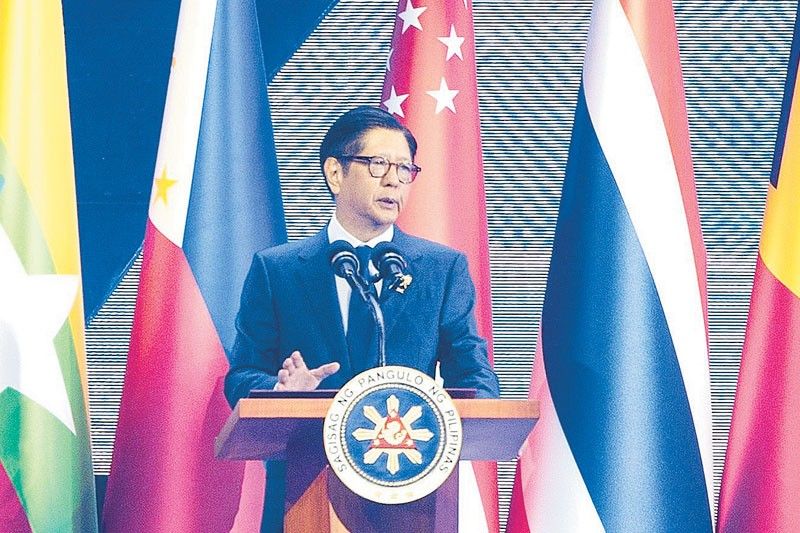
Speaking to the media after the leaders’ summit, President Marcos said the center would help ensure that the waters in the region are safe, its territories are well respected and the United Nations Convention on the Law of the Sea (UNCLOS) is adhered to.
“I suppose as the situation in the South China Sea becomes more, shall we say, unreadable, this becomes more important, that there is a center, that there will be a central repository for maritime issues and maritime policy that will apply to ASEAN members,” the President said.
Marcos acknowledged that a “big job” awaits the proposed center, given the immense vessel traffic in the South China Sea. Working together would prevent duplications and address gaps while maintaining peace in the strategic sea lane, the President added.
“And how to regulate that, how to monitor that is something that we are going to have to decide what to do. All the maritime countries around the South China Sea already do that, but they do that individually,” he said.
“The idea of the maritime center is to make a cohesive organization that will put together all the efforts of all the different countries, ASEAN and even other countries outside of ASEAN, who have an interest.”
Although ASEAN leaders fully agree with the concept of creating a maritime center, there is no timetable yet as to when it would be operational.
“The job before us is to put together the framework, what is this maritime center going to look like, who will be involved and... what their involvement will be. Who will fund it? Where will it be? What is it supposed to do in the first place? And all of those questions have yet to be answered,” Marcos said.
Marcos said he was “very optimistic” that the center would be established as the discussions on the matter “had progressed very, very quickly.”
Code of conduct
In 2002, ASEAN members and China forged the Declaration on the Conduct of Parties in the South China Sea to ease tensions and to resolve maritime disputes peacefully. However, a legally binding code of conduct has yet to be adopted.
Marcos said a binding code of conduct is needed to institutionalize the cooperation between ASEAN and China.
“Well, the basic fundamental foundation of any of those, to get the answer to any of those questions, will come from the finalization of the COC, the Code of Conduct. We cannot institutionalize any of those things until the Code of Conduct is finalized,” he said.
“That is one of our aspirations as chair of ASEAN for 2026, that we find at the end of the year that we actually have a Code of Conduct.”
Petroleum-sharing
Aware that “everybody is suffering” due to the Middle East war, ASEAN leaders are seeking the approval of a petroleum sharing deal to make the region more resilient during a crisis, but no timeline has been set for its execution even if it was deemed urgent.
Leaders of the regional bloc called for the expedited ratification of the ASEAN Framework Agreement on Petroleum Security (APSA), which ensures mutual support among member-states during supply shortages, President Marcos said.
They also pushed for the operationalization of the ASEAN Power Grid, which was intended to link the electricity networks of all 11 member-states to enable cross-border power trading, support renewable integration and deliver more affordable electricity to nearly 700 million people.?Although all Southeast Asian leaders regard the measures as crucial in ensuring energy resiliency, Marcos noted that they still have to be ratified by individual countries and that “everyone has a different schedule.”
“Our energy ministers haven’t yet met. So it’s impossible to say, they haven’t laid out, they haven’t met, therefore there is no, they haven’t laid out the timetable. But rest assured, the minute we have it, we will do the reform,” Marcos told a media briefing after the ASEAN Leaders Summit chaired by the Philippines.
Marcos gave assurance that ASEAN leaders would work “very hard” to get the energy resiliency measures done “as quickly as possible, in the best possible way.”
Vietnam rice deal
The Philippines has secured a rice import deal with Vietnam to ensure sufficient grain supply amid the anticipated drop in local harvest, the Department of Agriculture (DA) said.
The Philippines is expected to import 1.5 million metric tons of Vietnamese rice, ensuring uninterrupted supply of grain shipments until 2027.
The DA said Manila and Hanoi had agreed on a pricing of $450 per MT of the DT8 rice variety. The Vietnamese DT8 or five percent fragrant variant is currently priced at $406.6 per MT, as of March 26.
The agreement was signed by President Marcos and Vietnamese Prime Minister LÍ Minh H?ng during the ASEAN Leader’s Summit last Thursday.
Agriculture Secretary Francisco Tiu Laurel Jr. said the government is prioritizing stable rice supply as rising fuel and fertilizer costs coupled with the looming “super” El Niño threaten local rice production. — Adrian Kenneth Halili







- Latest
- Trending