SC affirms cops’ conviction in Kian slay
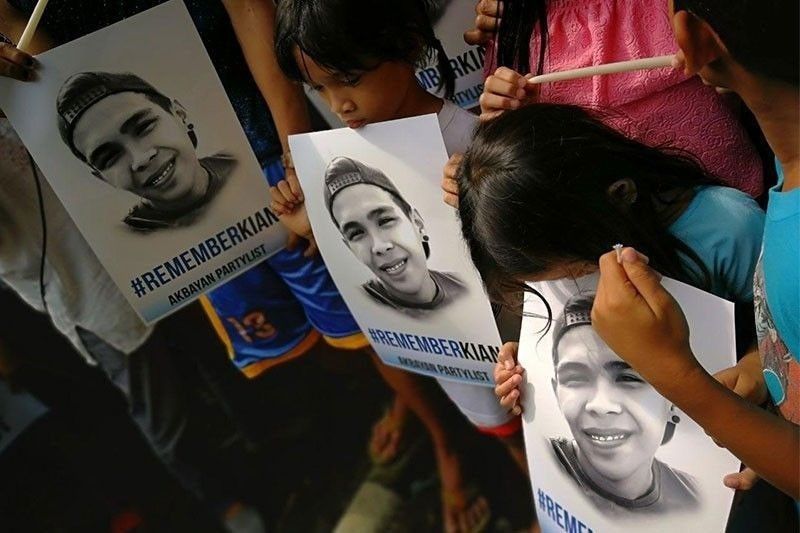
MANILA, Philippines — The Supreme Court has upheld the conviction for murder of three former Caloocan City policemen over the killing of 17-year-old Kian delos Santos in a drug war operation in 2017.
In a 39-page decision promulgated on Aug. 11 but released only yesterday, the high tribunal’s Second Division denied the petition for review of former Caloocan police officers Arnel Oares, Jeremias Pereda and Jerwin Cruz, seeking the reversal of the Caloocan City Regional Trial Court Branch 125’s decision finding them guilty of murder under Article 248 of the Revised Penal Code as well as the Court Appeal’s decision affirming the ruling of the RTC.
Oares, Pereda and Cruz were sentenced to up to 40 years imprisonment. They were also ordered to jointly pay the family of Delos Santos a total of P275,000 in damages.
The SC said the RTC as well as the CA were both correct in holding that the element of treachery, which qualifies a killing to murder from homicide, was present in the case.
The SC explained that treachery exists when the victim has no chance to defend himself or herself, and that the attacker deliberately chooses a means or method of attack that ensures the execution of the crime, eliminating any possibility for the victim to fight back such as by shooting the victim in vital areas, especially on the head, or attacking from behind.
Based on the testimonies of several witnesses, on the evening of Aug. 16, 2017 in Barangay Baesa, Caloocan City, Delos Santos was accosted and frisked by the three accused.
After supposedly finding suspected drugs, the three police officers punched Delos Santos as he cried and begged to be allowed to go home because he had an exam the next day.
The accused police officers then forced Delos Santos to hold a towel covering what appeared to be a gun and made him stand with his shirt raised to cover his head. Witnesses heard one officer ask whether they should take Delos Santos to the police station, to which the others replied, “Ibaba na lang natin ito (let’s just bring him down).”
The accused then dragged Delos Santos to a dark area near a river where he was shot multiple times by Oares and Pereda, while Cruz stood guard.
Oares, during the trial, admitted to shooting Delos Santos but claimed that it was done in self-defense as Delos Santos was supposedly firing at them.
In upholding the three former police officers’ conviction, the SC gave weight to the testimonies of several eyewitnesses as well as an autopsy report showing that Delos Santos sustained five gunshot wounds, two of which were to the head.
The SC gave special weight to the testimony of a medico-legal officer that based on the gunshot wounds, Delos Santos was likely sitting or kneeling when he was shot, debunking Oares’ claim.
The medico-legal report also showed that the bullets entered from the side and back of Delos Santos’ head, showing that he likely did not see his attackers and was unable to defend himself.
The high tribunal also noted that the officers deliberately took Delos Santos to a secluded location and placed him in a helpless position, enabling them to kill him “with impunity and ensuring the execution of the crime.”
The SC found no merit in the three police officers’ contention that there were inconsistencies in the witnesses’ testimonies, thereby affecting their credibility. The high court said minor inconsistencies or variance in the testimonies of witnesses were immaterial as these were not related to elements of the crime sufficiently established by the prosecution.
The SC also dismissed the accused’s claim that they were just performing their official duties, pointing out that this defense can only be invoked when the harm is an unavoidable result of a lawful police action.
“Even assuming that they were performing their duties as police officers, it is not shown that the killing of Kian is a necessary consequence of the due performance of such duty,” the decision penned by Associate Justice Jhosep Lopez read.
“On the day Kian was killed, Oares stated that they were conducting One Time Big Time Operation, while this was called Oplan Galugad by Pereda and Cruz. Regardless of nomenclature, the killing of a minor could not be considered standard in this operation,” it added.
The SC modified the three officers’ sentence from “reclusion perpetua without eligibility for parole” to just “reclusion perpetua.” The SC explained that ineligibility for parole shall only be meted against a convict if there is an aggravating circumstance that warrants the imposition of the death penalty if not for Republic Act 9346 which suspended the imposition of death penalty in the Philippines.





- Latest
- Trending