Collapsed Cebu structures in Project NOAH’s hazard maps

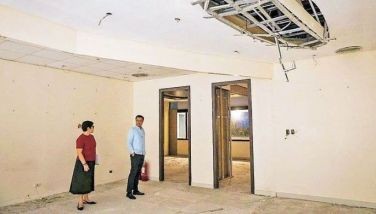
MANILA, Philippines — All structures that collapsed during the magnitude 6.9 earthquake in Cebu on Sept. 30 had already been identified as high risk in the hazard maps of Project NOAH, an expert from the University of the Philippines said.
UP Resilience Institute executive director Mahar Lagmay led a team of engineers in assessing the extent of damage in northern Cebu and in recommending safety measures to local and national authorities.
“A majority of the damaged houses were not as severe as what I imagined before doing fieldwork. Social media made me think that many houses crumbled or were toppled by the earthquake,” Lagmay noted on Facebook.
He also learned that “all the collapsed structures that they documented were already on the hazard maps of Project NOAH.”
“Three were built on waterways, one on a steep slope and one along the coast underlain by sediments,” he noted.
Launched in 2012, Project NOAH (Nationwide Operational Assessment of Hazard) was a government program that utilized science and technology to identify areas prone to natural disasters and empower local governments and communities to prepare for and reduce disaster risks.
With this vision, Lagmay said the team’s current findings would contribute to strengthening disaster risk reduction strategies nationwide, particularly in preparation for “The Big One,” which is expected to be a potential magnitude 7.2 earthquake along the Marikina Valley Fault System.
Philippine Institute of Volcanology and Seismology (Phivolcs) director Teresito Bacolcol said the government, in partnership with the Japan International Cooperation Agency, is set to revisit next year the 2004 study on the possible impact of “The Big One” in Metro Manila.
The two-decade-old study projected as many as 33,500 fatalities and 113,600 injuries in the capital region, which then had a population of 9.9 million.
Including nearby provinces, the projected death toll could reach 48,000, Bacolcol said.
Coastal subsidence
Following Cebu’s magnitude 6.9 earthquake, the Department of Science and Technology and its attached agencies reported several geological effects across the province.
Phivolcs observed signs of coastal subsidence in Barangay Hagnaya, San Remigio, where the sea level has noticeably advanced inland after the quake.
The movement of the Bogo Bay Fault, which generated the quake, caused portions of Hagnaya Port and nearby structures to become submerged during high tide.
“The northeastern portion of the Hagnaya Port and the ground in the building’s vicinity subsided and became inundated by seawater during high tide,” Phivolcs said, citing findings from its Quick Response Team.
Meanwhile, the Department of Environment and Natural Resources-Mines and Geosciences Bureau (MGB) reported the appearance of 14 new sinkholes in Bogo City and San Remigio, on top of the 198 previously identified in the same areas.
Science Secretary Renato Solidum Jr. also urged the Bogo City local government to take immediate action following the discovery of the inland extension of the Bogo Bay Fault in Sitio Looc, Barangay Nailon, which may stretch up to 1.5 kilometers.
As local and national agencies continued to assess the damage and assist communities reeling from the quake, international partners also joined relief efforts in Cebu.
The Philippine Air Force and the Japan Air Self-Defense Force have begun their first joint military exercises under the Reciprocal Access Agreement (RAA) between Japan and the Philippines.
Dubbed Doshin-Bayanihan 5-25, the training exercise runs from Oct. 7 to 11 at the Benito Ebuen Air Base in Mactan, Cebu, marking the inaugural implementation of the RAA, which entered into force last Sept. 11. – EJ Macababbad, Alden Monzon, Michael Punongbayan





- Latest
- Trending