


Palace activates national disaster response plan
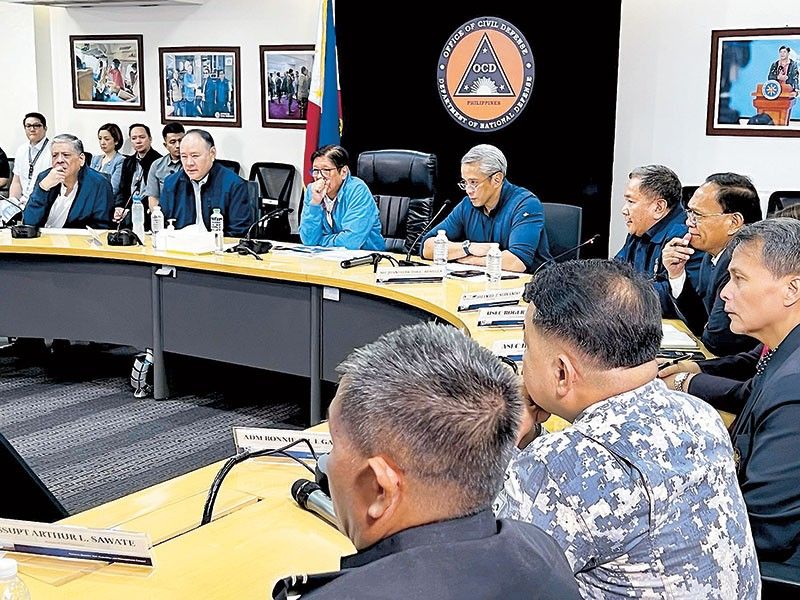
MANILA, Philippines — As the country grapples with the effects of recent cyclones, Malacañang ordered national government agencies to implement the 2024 National Disaster Response Plan (NDRP), which contains strategies to effectively mitigate calamity risks and effects and ensure the timely delivery of aid to affected areas.
The government adopted the response plan through Memorandum Circular No. 100 signed by Executive Secretary Lucas Bersamin by the authority of President Marcos last Sept. 23.
“It is imperative for all national government agencies and instrumentalities, including government-owned or controlled corporations and LGUs (local government units) to support and cooperate towards the successful implementation of the 2024 NDRP,” the memorandum circular read.
“In accordance with their respective mandates, all concerned agencies and instrumentalities of the national government, including government-owned or controlled corporations, are hereby directed, and all LGUs are hereby encouraged, to undertake efforts in support of the implementation of 2024 NDRP, and the plans and programs specified therein,” the memo added.
The Office of Civil Defense was tasked to coordinate closely with the Presidential Communications Office to disseminate the plan to all concerned government entities.
The plan is in line with the Philippine Disaster Risk Reduction and Management Act of 2010, which adopted a paradigm shift from reactive to proactive approach to disaster risk management. It contains the mechanisms, guiding principles, goals and strategies and institutional arrangements to effectively plan and implement disaster response and early recovery even before disaster happens.
53 areas placed on alert
The Department of the Interior and Local Government (DILG) placed Metro Manila and 52 provinces on alert as local government units brace for the impact of Severe Tropical Storm Opong (international name Bualoi).
Sixteen areas under Alert Level Charlie were Albay, Bataan, Batangas, Camarines Norte, Camarines Sur, Catanduanes, Cavite, Laguna, Marinduque, Masbate, Northern Samar, Occidental Mindoro, Quezon, Rizal, Sorsogon and Metro Manila.
These areas are within a 100-kilometer diameter radius and under direct threat from Opong. The DILG said LGUs should prepare for intense winds and torrential rains that may cause floods, landslides and damage to critical infrastructure.
Ten provinces are under Level Bravo and may experience strong winds of up to 85 kilometers per hour and heavy to intense rains.
Twenty-seven provinces are under Alert Level Alpha which may experience moderate to heavy rains. These are Abra, Aklan, Antique, Benguet, Biliran, Bohol, Capiz, Cebu, Dinagat Islands, Guimaras, Ifugao, Ilocos Sur, Iloilo, Isabela, Kalinga, La Union, Leyte, Mountain Province, Negros Occidental, Negros Oriental, Nueva Vizcaya, Palawan, Pangasinan, Quirino, Southern Leyte, Surigao del Norte and Surigao del Sur.
The DILG ordered LGUs in the affected areas to activate Operate Listo protocols, initiate pre-emptive evacuation of at-risk communities and secure evacuation centers with adequate food, water and medical supplies.
The Department of Social Welfare and Development is on red alert for Severe Tropical Storm Opong, DSWD Assistant Secretary and spokesperson Irene Dumlao said yesterday.
Dumlao said that 5,433 quick response team members of the DSWD were deployed since yesterday to ensure immediate response and assistance.
“The DSWD is ready. We have more than 2.5 million family food packs prepositioned in various parts of the country, in those areas that will be hit by Opong. Particularly in Region 8, we have 157,295 family food packs prepositioned there,” Dumlao said in a press conference.
Code White
The Department of Health (DOH) has raised the White Code Alert to ensure hospitals and health facilities can immediately respond to any incident needing medical attention as Tropical Storm Opong is expected to make landfall today.
“With Typhoon Opong expected to make landfall in the country on Friday, September 26, the DOH has raised the Code White Alert,” the DOH said in a social media post.
Under the Code White Alert, the DOH Operations Center ensures medicines and medical equipment are available. It also requires health emergency response teams to be ready in serving residents in typhoon-hit regions.
The DOH added the three Philippine Emergency Medical Assistance Teams (PEMAT) recognized by the World Health Organization, are also placed on standby in case their assistance is needed in any hospital that will be affected by Opong.
PNP is ready
Acting Philippine National Police (PNP) Lt. Gen. Jose Melencio Nartatez Jr. yesterday ordered police commanders in Bicol, Eastern Visayas, Calabarzon, Mimaropa and Metro Manila to be on alert and ensure full coordination with LGUs and disaster management offices in preparation for the incoming storm.
“From preemptive evacuation to search and rescue operations, our personnel on the ground are ready to respond to any request for assistance and any eventuality,” Nartatez said.
Police forces in the five regions will also secure evacuation centers, assist in the distribution of relief assistance and help clear road net- works to ensure the smooth flow of relief aid. – Emmanuel Tupas, Jose Rodel Clapano, Rhodina Villanueva





- Latest
- Trending


