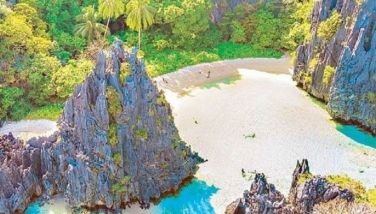
Philippines protests China’s plan to build ‘nature reserve’ at Scarborough
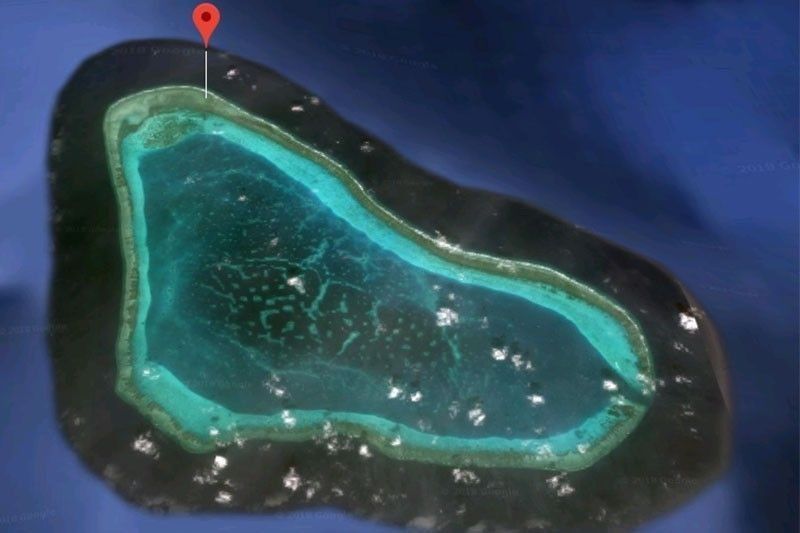
MANILA, Philippines — The Philippines has condemned China for its plan to establish a so-called "national nature reserve" in Bajo de Masinloc (Scarborough Shoal) — the latest in a string of moves by Beijing to step up its control over the feature.
The Department of Foreign Affairs (DFA) said Thursday, September 11, that it will file a formal diplomatic protest to oppose China's planned construction of the "Huangyan Island National Nature Reserve," warning that the move violates Philippine sovereignty and international law.
Beijing refers to Bajo de Masinloc as Huangyan Dao.
"Bajo de Masinloc is a longstanding and integral part of the Philippines over which it has sovereignty and jurisdiction," the DFA said.
"The Philippines likewise has the exclusive authority to establish environmental protection areas over its territory and relevant maritime zones," it added.
The DFA said the move is an "illegitimate and unlawful action by China" as it "clearly infringes upon the rights and interests of the Philippines in accordance with international law."
China's State Council approved the creation of the 3,523-hectare "Huangyan Island National Nature Reserve" yesterday, with Beijing's forestry administration later saying it would focus on conserving coral reef ecosystems, according to Chinese state media.
Details shared by Chinese state media show that the nature reserve will be set up on China's southernmost island city of Sansha — the prefecture-level city that Beijing established in 2012 to assert its claims in the South China Sea.
China's State Council also ordered its agencies to strengthen law enforcement against "all types of illegal and irregular activities within the nature reserve" — language that indicates Beijing intends to more strictly police the area and drive out foreign vessels.
The statement by the DFA on Thursday urged Beijing to “respect the sovereignty and jurisdiction of the Philippines over Bajo de Masinloc, refrain from enforcing and immediately withdraw its State Council issuance, and comply with its obligations” under the United Nations Convention on the Law of the Sea (UNCLOS), the 2016 arbitral award on the South China Sea, and the 2002 Declaration on the Conduct of Parties in the South China Sea.
What came before. China’s plan to create a “nature reserve” comes after a year of steadily intensifying activity around the disputed reef.
Presence of China Coast Guard (CCG) and Navy vessels has steadily grown in the waters around Bajo de Masinloc since January.
Chinese vessels and air assets were also dispatched to and over the area in August, shortly after a rare collision between a People's Liberation Army Navy vessel and CCG vessel during a high-speed chase of a Philippine patrol boat.
Bajo de Masinloc lies about 120 nautical miles west of Zambales and has been a flashpoint in Philippine-Chinese relations for more than a decade.
In 2016, a tribunal in The Hague ruled in favor of the Philippines, declaring that China’s expansive “nine-dash line” claims in the South China Sea had no legal basis. The ruling also found that China had violated the rights of Filipino fishers by blocking their access to Scarborough Shoal.
Beijing has rejected the ruling and continued to expand its presence in the disputed waters.





- Latest
- Trending