Coast Guard confronts 3 Chinese research ships off Zambales, Palawan

MANILA, Philippines — Three Chinese research vessels have entered the Philippines’ exclusive economic zone (EEZ) without authorization, the Philippine Coast Guard said on Thursday, July 31.
In a statement, PCG spokesperson Jay Tarriela said Commandant Admiral Ronnie Gil Gavan immediately ordered to intercept and challenge the ships over suspected “illegal marine scientific research activities.”
The three Chinese research vessels were monitored through Canada’s Dark Vessel Detection Program, a satellite tracking system for ships that typically become undetectable when their transmitting devices are switched off.
A vessel is considered “dark” when it disables its tracking systems to conceal its activities and evade surveillance. Dark vessels pose potential security threats to maritime communities.
First vessel. The civilian research vessel "Bei Diao 996" was last spotted 185 nautical miles off Zambales, but Tarriela said it had been conducting marine research operations closer to Bajo de Masinloc, some 40 nautical miles west of the Zambales coast.
The vessel was described as China's largest deep-sea research test ship with the distinction of being the world's biggest SWATH catamaran. This vessel has a twin-hull design that provides stability in rough seas and is short for small waterplane area twin hull (SWATH).
With dual-use capabilities, the vessel can conduct both scientific and civilian research. It also specializes in testing underwater acoustic sensors and sonar equipment.
The ship left China's Guangdong Province on June 16 and entered Philippine waters about a week later, Tarriela said.

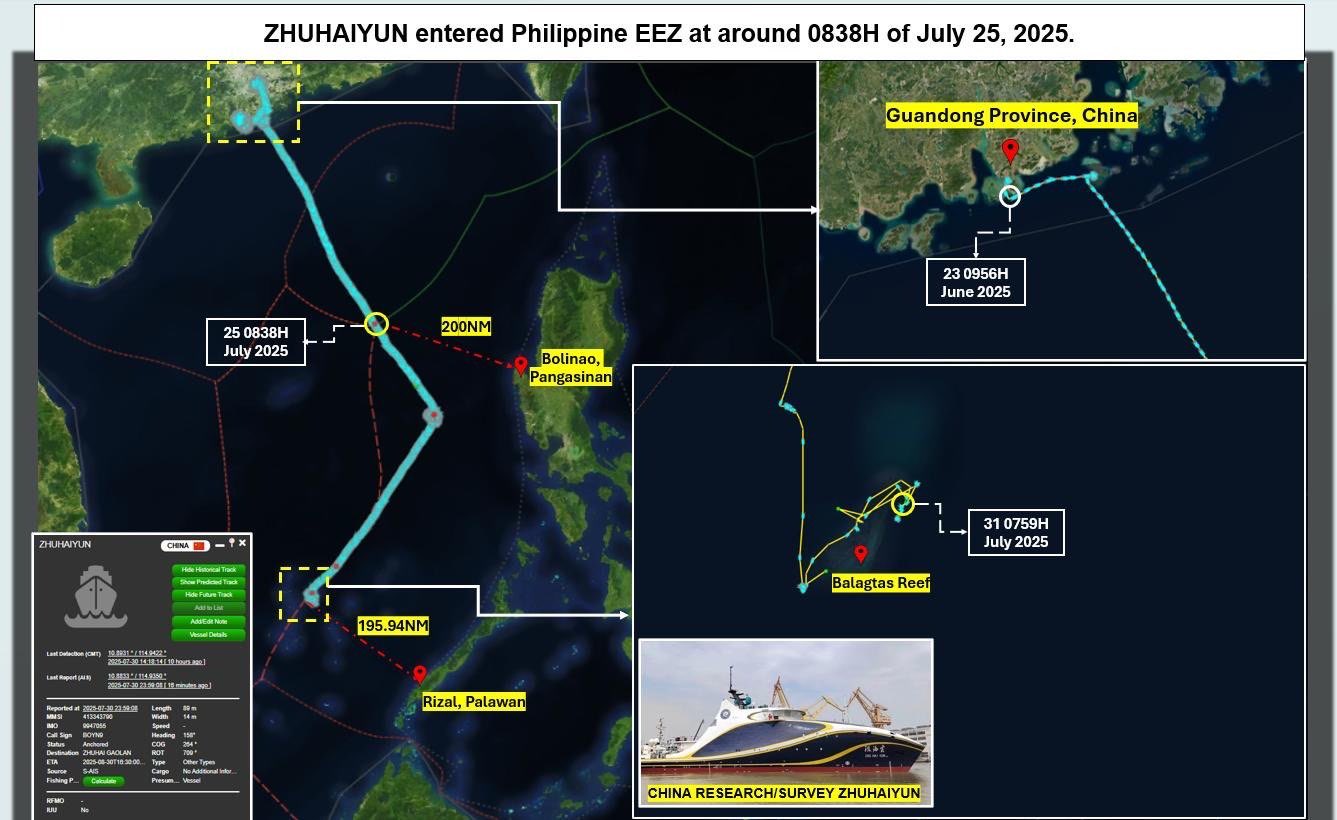
Second and third vessels. Two other Chinese research vessels, "Xiang Yang Hong 10" and "Zhuhai Yun," simultaneously breached Philippine waters on June 25, appearing 200 nautical miles off Bolinao, Pangasinan.
Their coordinated deployment near Balagtas Reef suggested a joint research mission, with both ships currently positioning themselves 195 nautical miles from Rizal, Palawan, according to the PCG.
Both vessels possess advanced marine research capabilities.
The Coast Guard said the Xiang Yang Hong 10 is a multi-role research vessel capable of conducting deep-sea surveys and operating unmanned autonomous underwater vehicles for seafloor mapping and environmental assessment.

The vessel is also designed for ice-breaking operations and features precision positioning technology for scientific research.
Meanwhile, Zhuhai Yun is described as the “world’s first intelligent unmanned drone carrier,” which is a type of ship that has no need for a crew to launch, recover and coordinate drones.
The Coast Guard said the vessel is “designed for oceanographic research but has significant military dual-use potential, including mapping submarine routes and deploying smart mines.”
“The PCG remains committed to safeguarding the maritime domain and will take all necessary actions to enforce laws and protect national interests,” Tarriela said.
The repeated incursions of Chinese research vessels into Philippine archipelagic waters without authorization have demonstrated ongoing tensions.
This comes as Beijing continues to assert maritime claims over the South China Sea, which a 2016 international tribunal ruling has already nullified. — with reports from Cristina Chi


- Latest
- Trending