Stronger gov’t recognition of Muslim culture, holidays urged
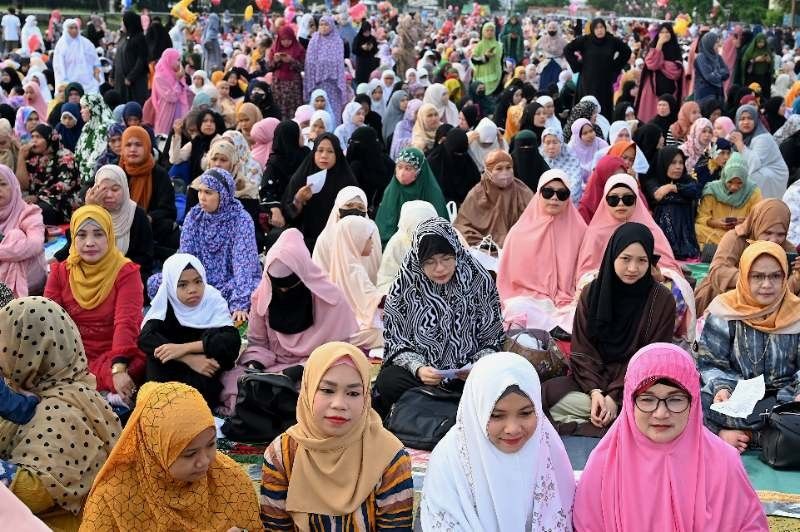
SINGAPORE — Despite official recognition of Muslim holidays, a peace advocate said the Philippine government must pursue a “meaningful recognition” to foster social cohesion.
Ariza Nocum, co-founder and president of KRIS For Peace (Kristyano-Islam Peace Library), pointed out the gap between token recognition and meaningful inclusion, saying that many Filipinos still remain unaware of the significance of Muslim holidays.
“There's still so much more that needs to be done, as if we're not just doing token recognition, but that we're also doing meaningful recognition, that we're truly investing to make people understand,” Nocum said in an interview with Philstar.com on June 24, in a mix of English and Filipino.
Nocum, reflecting on her experiences at the International Conference on Cohesive Societies (ICCS) held in Singapore, observed that while the Philippines recognizes Muslim holidays, its approach falls short compared to Singapore’s.
She noted that in Singapore, despite possibly having a smaller Muslim population, these holidays are widely celebrated, with mall displays, street decorations, and public signage reflecting the festivities.
“Even the malls have exhibits, even the streets have signs and celebratory decorations. Meanwhile, in the Philippines, you don't really see that,” she said in a mix of English and Filipino.
According to Singapore’s 2020 census of population, 15.6% of the population are Muslims, with an estimated population of over 539,251.
Open spaces for dialogue. Nocum also emphasized the need for open spaces for dialogue on all ideologies, saying that freedom of expression and media freedom are critical for this to be achieved.
She suggested that environments allowing for diverse perspectives are optimal. However, she cautioned that while encouraging diverse viewpoints, there is also a need to form a society based on common values, which she believes is currently lacking in the Philippines.
“Feeling ko kulang pa 'yun sa Philippines. Kasi somehow may sense tayo who is a Filipino. Meron 'yung pagiging masayahin, pagiging matulungin, pagiging pakikipagkapwa,” Nocum said.
(I feel that's still lacking in the Philippines. Because somehow we have a sense of who a Filipino is. There's being joyful, being helpful, having a sense of community.)
(It hasn’t been defined yet to the point where it’s like, okay, this is who we are and no matter what the ideology is, the values would still be more important.)
“Hindi pa siya nade-define to the point na parang, okay, eto tayo and no matter what ideology, the values would still be more important,” she added.
(It hasn’t been defined yet to the point where it’s like, okay, this is who we are and no matter what the ideology is, the values would still be more important.)
KRIS for Peace. She further explained that her organization, KRIS for Peace, actively works to teach these important values through information campaigns.
As an example, she cited celebrating World Hijab Day, where they facilitate conversations between Muslim and non-Muslim Filipino women about the hijab, allowing Muslim women to share their significance as part of their identity and confidence.
She also mentioned partnerships to create videos sharing personal stories of religious coexistence and the inspiring work of youth leaders who, despite experiencing violence and displacement, are engaged in community-based initiatives to promote collective action and inspire others.
Unaddressed conflicts. Nocum also said the Philippines still faces numerous unaddressed tensions and conflicts, extending beyond physical confrontations.
“Sometimes, it's tension or discrimination or prejudice that we see even online now, and for me, it has many factors. You have religious differences, you have political differences,” she said in a mix of English and Filipino.
“We see that online every day,” she added.
Some of these tensions, according to Nocum, stemmed from the country’s colonial past.
“We have a colonial history. All the different wars that happened before when the Spanish came in…We still have so many unaddressed issues,” Nocum said in Filipino.
“But in the Philippines, we have to do a lot more work and that work, putting social cohesion, bringing people together. Peace-building, it's important for many reasons,” she added.
She cited an instance of a multifaceted impact of unresolved conflict, particularly in Mindanao, where she said it worsens poverty by causing displacement, destroying livelihoods, hindering education and affecting the national image, business and investments.
“Every time there's a conflict, an attack, a terrorist incident, it affects the whole community. Communities, in fact, people get displaced,” Nocum explained.
To address these issues, she urged the importance of collective action in achieving sustainable development, noting the Philippines has not yet reached a point where all sectors of society are included.
“Dapat sama-sama tayo. Sa development, when we're talking about sustainable development, wala pa tayo sa point na nahahatak natin lahat,” she said.
(We should be moving forward together. When we talk about sustainable development, we’re not yet at the point where everyone is being brought along.)
--
Editor's note: The trip to Singapore was hosted by Singapore’s Ministry of Culture, Community and Youth (MCCY). At no stage does the host organization have a say on the stories generated from the coverage, interviews conducted, publication date and story treatment. Content is produced solely by Philstar.com following editorial guidelines.





- Latest
- Trending