The Philippines is the game changer ASEAN has been waiting for
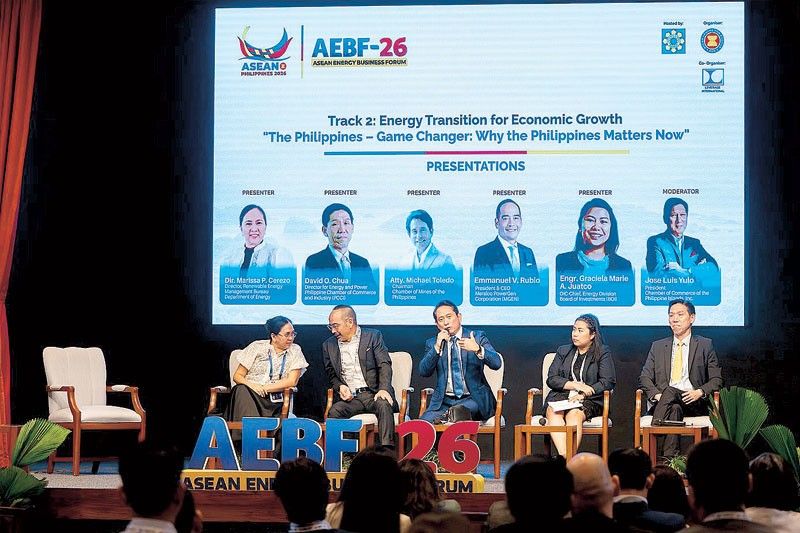
At the ASEAN Energy Business Forum (AEBF-26) in Metro Manila, held under the theme “Energy Transition for Economic Growth,” I took part in a plenary session on Day 4 with a title that carries real weight: “Philippines – Game Changer: Why the Philippines Matters Now.”
I joined the panel as chairman of the Chamber of Mines of the Philippines and COO of Silangan Mindanao Mining Co. Inc., and I believe the mining industry belongs in this conversation as much as any power producer.
Co-hosted by Prime Infrastructure, the session was moderated by Jose Luis Yulo, president of the Chamber of Commerce of the Philippine Islands, Inc. The panel included director Marissa P. Cerezo of the Department of Energy’s Renewable Energy Management Bureau; David O. Chua of the Philippine Chamber of Commerce and Industry; Emmanuel V. Rubio, president and CEO of Meralco PowerGen Corporation (MGEN); and engineer Graciela Marie A. Juatco of the Board of Investments.
This mix of government, investment, business and industry voices once again proved that energy transition cannot be built by any one sector.
MGEN president and CEO Manny Rubio framed the discussion simply. “If you want to understand why the Philippines matters in the energy transition,” he said, “we can start with a map.” An archipelago of more than 7,100 islands has long meant a more complex energy system, but he argued that complexity is also an opportunity, because the questions the Philippines is solving are “increasingly the same questions facing many energy markets across the region.”
He also showed that capital has already come at scale. After the 2022 amendments to the implementing rules and regulation of the Renewable Energy Act of 2008, allowing 100 percent foreign ownership of solar, wind, hydro and ocean energy projects, UK-based Actis agreed in 2024 to invest $600 million for a 40 percent stake in MTerra Solar, the largest foreign direct investment in a single greenfield infrastructure project in the country.
Manny’s conclusion: “Capital can come into the Philippines at scale when the opportunity is credible, participation is open, and projects can demonstrate scale.”
From geothermal and offshore wind to solar potential, the Philippines has a diverse resource base. It also has critical minerals, such as nickel and copper, that sit at the heart of clean energy supply chains. Batteries, transmission lines, solar panels and wind turbines all begin in the ground.
A country that wants to matter in the energy transition cannot talk only about generation. It must also talk about the materials that make generation possible, and about mining done responsibly, transparently and in partnership with host communities.
That is the message I carry as Chamber chairman and Silangan COO. The Philippines should aim to be more than a source of raw materials. With sound policy, we can move up the value chain, attract investment into processing and manufacturing, and secure a stronger place in regional supply chains. That requires the same qualities every panelist pointed to: policy certainty, coordinated government action and respect for environmental and social safeguards.
Manny put the central challenge well: “How do we make the next investment easier than the last one?” He identified three areas, and each applies to mining as much as to power.
On national and local alignment, he noted that permitting needs rigor but not repetition: “There is a difference between rigorous permitting and repetitive permitting.” Investors, he said, look beyond returns to “certainty or predictability.”
On the grid, he said generation and transmission “have to evolve together,” and urged planners to anticipate where renewable zones, offshore wind and new industrial demand will emerge.
On decentralized energy, he described rooftop solar, storage and micro grids as meant “not to replace the grid, but to complement it,” with solutions that could serve other archipelagic markets in Southeast Asia.
My own takeaways from the panel discussion, moving forward:
First, treat minerals and energy as one strategy. Supply chains for the transition run from mine to grid, and policy should be planned that way.
Second, make certainty the national brand. Clear timelines, digitized processes and consistent rules across agencies and local governments are the most powerful incentives we can offer.
Third, build resilience into the system, through decentralized solutions suited to an archipelago and supply chains that do not depend on a single source.
Fourth, keep communities at the center. Energy and mining projects earn their place only when they deliver benefits that people can see.
As Manny Rubio had said in closing, which is apropos not just for the panel discussion but for the whole forum: “The real opportunity before us is not simply to build more energy projects. It is to build an energy system that makes the next generation of projects possible.”
The Philippines has the resources, the reforms and the track record. Potential alone does not make a game changer. It should also be delivery. *




- Latest