


Ex-CJs to Senate: You decide on 16-vote threshold
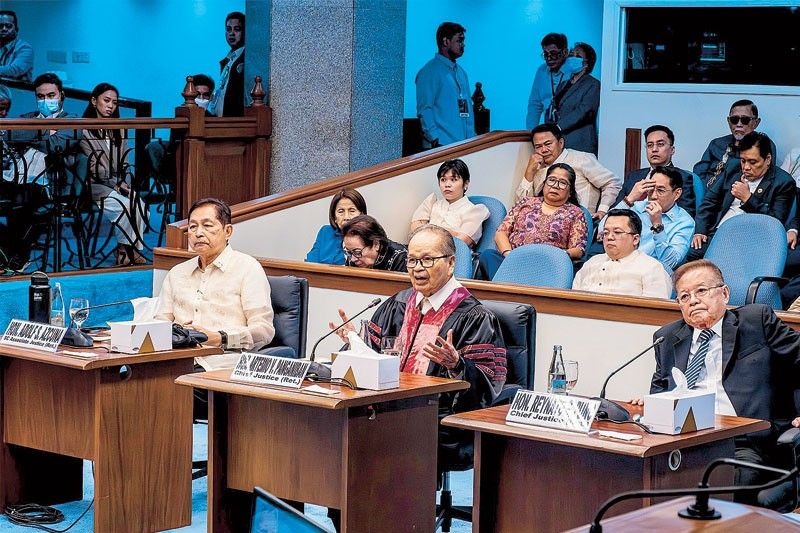
MANILA, Philippines — Three former chief justices stated that the two-thirds threshold to convict Vice President Sara Duterte is not fixed at 16 of the 24 senators, and said the decision ultimately lies with the Senate.
Retired chief justices Artemio Panganiban and Reynato Puno, and retired Supreme Court associate justice Adolfo Azcuna faced the Senate impeachment court yesterday to give their respective positions on the 1987 Constitution’s impeachment clause of “two-thirds of all the members of the Senate” for the conviction of an impeachable official.?
Among the four amici curiae, which included retired chief justice Hilario Davide Jr. who submitted his written position, only Azcuna held his ground that the literal reading of the provision required the fixed number of 16, regardless of the absence of senators who are on leave, at large or detained and not physically present during the trial.
Panganiban quoted the legal maxim “ratio legis est anima (the reason of the law is the soul of the law),” to describe the mathematical equation “two-thirds” of all members as an “abstract science” that must be adjusted to “reality.”
Panganiban likened the threshold vote to a “small drop of water, when put together with another small drop of water, may become in reality one bigger drop of water.”
“Reality sometimes changes the denominator in mathematics,” Panganiban said, adding that “constitutional interpretation cannot always stop at abstract mathematics.”
Puno said the impeachment conviction clause should not be taken on its “text” alone, but should be read in its “context.”
Puno pointed out that the 1987 Constitution did not explicitly put the number to convict at 16 and that it is “inappropriate” to give the impeachment clause a “stand-alone literal reading” of setting the number to convict as “fixed and immutable.”
A “functional” reading would allow the senators to consider their unique situation of having their active roster diminished because of the legal and health status of four members, Puno said.
Davide – a framer of the 1987 Constitution – defined “all members of the Senate” in the Charter as those who are “not suffering from any mental, physical or health conditions which render them incapable of exercising their powers or performing their duties as senators, or who are prohibited to do so by reason of some legal restraints or impediments.”
Azcuna, another framer of the 1987 Constitution, said “all members of the Senate” can only mean 24 and that “all means all.”
Azcuna said the overwhelming number of votes to convict at 16 was intended to make the impeachment process more difficult and prevent it from being abused by a political “super majority,” which may seek to remove an impeachable official despite an electoral mandate.
Senate decision final
The impeachment court’s verdict is final and cannot be appealed before the Supreme Court unless there is “grave” abuse of discretion, the retired chief justices stated.
Panganiban said the Senate’s authority to try and decide Duterte’s impeachment is absolute and should not be bogged down by strict legalism.
“Is the judgment of the Senate based on truth and fairness appealable to the Supreme Court? My respectful answer is a big no,” Panganiban said.
“The Senate’s decision is final and unappealable,” he added, saying the Senate is the “Supreme Court of impeachment(s).”
He clarified that the high tribunal can only intervene if the Senate commits grave abuse of discretion, which jurisprudence defines as a “capricious, whimsical or arbitrary exercise of judgment.”
“In simpler terms, the court does not review the Senate’s judgment merely because the court disagrees with the judgment, merely because the court disagrees with the wisdom of the judgment,” he explained.
Puno said the Senate court possesses the “sole” power to interpret the constitutional provision requiring the concurrence of two-thirds of all the members.
“In discharging this judicial power, the Senate impeachment court is not under the Supreme Court,” Puno manifested, rejecting the notion that the high court should dictate the threshold.
“Nowhere does it explicitly appear in Article 7 [Judicial Department] that the Supreme Court can review the rules of the Senate impeachment court,” he added.
Puno explained that determining whether to adjust the threshold to exclude absent or detained lawmakers is a “political question” addressed solely to the wisdom of the senators.
However, he echoed Panganiban’s warning that the Supreme Court could strike down the proceedings as unconstitutional if the Senate’s internal rules deny the respondent their right to due process, such as the right to be judged by fair and impartial judges.
Panganiban called on the senators to act as lawmakers representing the people, rather than attempting to copy jurists or magistrates.
He emphasized that the impeachment tribunal is a sui generis (unique) body that blends legal and political processes.
“To me, legalities do not matter very much because our people are not lawyers. They are not jurists. They are not used to objecting to leading questions or misleading questions. They are not used to technicalities,” Panganiban told the chamber.
“The important thing for the Senate, in my humble opinion, is that the Senate is able to answer the call for truth and fairness. Never mind the technicalities, (but) truth and fairness,” he added.
He argued that if the framers of the Constitution wanted a purely legal proceeding governed by strict judicial technicalities, they would have assigned the power of impeachment to the SC.
The Senate may skip its vote to resolve the possible deadlock on the threshold of 16 if Escudero “changes his mind” and reverses his initial ruling, according to Panganiban. – Neil Jayson Servallos, Helen Flores


- Latest
- Trending


