


A life-changing hope for people with HIV
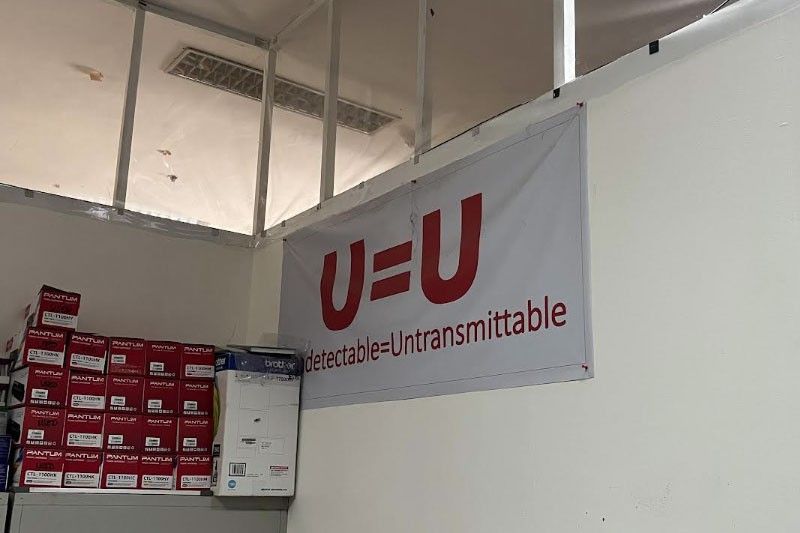
CEBU, Philippines — At a human immunodeficiency virus (HIV) care facility in Mandaue City, a tarpaulin reads U=U hanged in a corner with bold red letters is more than just a display – it represents a milestone, a message of hope, and a symbol of success for all the clients who walk through its doors.
At present, HIV awareness extends beyond prevention; it encompasses empowerment, access to testing and treatment, and the opportunity to live a full, healthy life.
Among the doors that remain wide open are Mandaue City Health Office (MCHO), the Substance Abuse and Mental Health Services Office (SAMHSO), and advocates within the community, where powerful message continues to gain ground: U=U, or Undetectable = Untransmittable.
Life-changing truth, hope
According to the Joint United Nations Programme on HIV/AIDS (UNAIDS), U=U, short for Undetectable = Untransmittable, means that when a person living with HIV consistently follows antiretroviral treatment, the virus in their blood drops to an undetectable level. At this point, the risk of transmitting the virus to others is reduced to zero.
More than a campaign, U=U is a life-changing truth and hope for people living with HIV (PLHIVs).
Dayne (not his real name), 24, first learned about his HIV status in 2023. He discovered it during an LGBTQ+ community seminar in Mandaue City organized by AIDvocates, a group advocating for HIV awareness and response.
By chance, he reconnected with a friend who was an HIV advocate and encouraged him to get tested.
It was not Dayne’s first time to undergo an HIV test. But when the lines on the kit turned positive, he tried to convince himself otherwise.
“Maybe the kit was expired,” he told his friend—a truth he was too afraid to accept.
Yet, several confirmatory tests showed the same result: he was positive for HIV.
Dayne is among the 600 PLHIVs who regularly visit the Mandaue City Health (MCH) – Social Hygiene Clinic and Primary HIV Care Facility. For him, the clinic is more than just a place to get medicine—it is a safe space where he feels understood and cared for.
As of August 4, 2025, the facility is handling 626 HIV cases. Most of these are men who have sex with men (MSM), accounting for 488 cases. There are also 85 transgender clients, people who inject drugs (PWID) with 38 cases, and 15 cases from other groups.
Before knowing his status, Dayne had already been feeling the effects on his body.
He recalled being extremely weak, suffering from constant back pain, and losing interest in work and eventually came to the point that his weight dropped to just 46 kilos, his frame reduced to skin and bones.
He did not waste time. Dayne immediately began his medication at the Cebu City Health Office before being transferred to the Mandaue City Health facility in April this year.
Stigma and discrimination
For many PLHIVs, the biggest fear is not how society will treat them, but how their own families will react.
Dr. Delore Flores shared that denial often stems from this fear of judgment at home. The thought of parents finding out, of a mother’s disappointment or a father’s anger, becomes heavier than the illness itself.
Nurse Miraflor Cabatingan of MCH has witnessed how deeply family support can change a client’s journey.
She recalled how those whose families stand beside them show brighter emotional health and stronger treatment outcomes.
Their progress is visible—faster, steadier, and lighter—compared to those who carry the burden in silence.
“Kung grabe ang support, nindot kaayo ang emotional health and ilang treatment outcome nindot pod kaayo lahi ra gyud sa kung sila-sila lang,” said Cabatingan.
Looking back, Dayne admitted that denial came not from the diagnosis itself but from fear of stigma and discrimination. He once experienced having his utensils separated from others—a painful reminder of how misconceptions persist.
Health experts continue to emphasize that HIV cannot be transmitted by sharing food or utensils.
Dayne also reflected on his past, admitting that he once became hooked on dating apps, meeting different men almost daily and engaging in unprotected sex.
Without condoms, lubricants, or Pre-Exposure Prophylaxis (PrEP), he believes this behavior led to his HIV infection.
With HIV being a lifetime condition that requires lifelong medication, a strong support system becomes as essential as the treatment itself.
Just like Dayne, while his siblings knew his status, his parents did not. He was afraid they might worry—not because of judgment, but because of worry that his parents are old enough to carry such news.
Acceptance, after all, is not only about lowering viral load. For Dayne, it is also about unloading the emotional weight of fear, shame, and loneliness.
Support group for PLHIVs
According to Flores, the clinic does not serve Mandaue City alone—it has become a hub for neighboring areas, including Cebu City and northern Cebu such as Liloan and Consolacion.
For many, it is the nearest and only treatment center where lifesaving medication is available.
“We make sure that the moment a client tests reactively, everything they need is already provided—from laboratory tests to treatment,” Dr. Flores said, noting that the clinic is able to sustain its free services because of partnerships with Non-Government Organizations (NGOs) that support MCH’s programs.
They work hand in hand with Sustained Health Initiatives of the Philippines (SHIP), the AIDS Healthcare Foundation, and the International Center for AIDS Care and Treatment of the Philippines. These organizations extend support through manpower, laboratory services, medicines, and even transportation assistance—helping ensure that PLHIVs, especially indigent clients, can fully access the care they need.
For Mandaue City Health, addressing HIV is not just about suppressing the virus. It is about supporting the whole person—checking both viral load and mental well-being, and making sure no one feels alone in their journey.
“We encourage them to come here, ma- assess mentally and ma-assess ang viral load and at least ma-encourage namo sila nga ma achieve ang U=U,” said nurse Cabatingan.
She emphasized that the Social Hygiene Clinic and Primary HIV Care Facility is a one-stop shop—not just for HIV but also for overall lifestyle and well-being taking on a holistic approach.
Clients are reassured that once they come in for testing and treatment, everything else will be taken care of.
With the clinic and its partners sharing the responsibility, PLHIVs only need to focus on staying committed to their medication and treatment journey.
“Mao na among narrative sa among clients kami nay bahala nimo ari lang gyud diri. Pa test ka, inom, and anhi diri,” said Flores.
“Kugi lang imoha, kami nay bahala nimo,” the doctor added.
True to their mission, the Mandaue City Health facility revived its Learning Group Session for PLHIVs last July, bringing together both old and new clients who are willing to disclose their status.
Nurse Cabatingan explained that the sessions gather PLHIVs from different generations—those who have already accepted their condition and those who are still in the process of acceptance. They share their personal journeys, including the struggles they faced before reaching stability and achieving U=U status.
For clients who continue to struggle with denial, these stories provide encouragement and a sense of hope, Cabatingan added.
Dayne, for his part, said what he truly needed was family support, and thankfully, the Mandaue City Health gave him a space where he could feel that sense of belonging.
For Cabatingan, the clinic’s role goes beyond handing out Antiretroviral (ARV) therapy.
“We sit down with our clients, talk to them one-on-one, and assess their needs—including their mental health,” Cabatingan explained.
“They are guided all throughout their treatment,” she added.
Treatment in their hub is also personal. A simple text message or phone call—whether to remind clients to take their medication or to ask how they are—goes a long way in making them feel cared for.
The support group which was first created in 2018 only has five members. Now, with its revival, more clients are opening up and sharing their experiences.
Cabatingan noted that the group has become especially helpful for new clients.
With the revival of the group session in the hub, Dayne said he finally has a space where he can open up. Having a safe place to release his worries and talk to people who truly understand, he said, has been a huge help in lightening the weight on his mind.
“There are many thoughts that run in our minds,” Dan admitted.
For him, advice from fellow PLHIVs carries more meaning than from anyone else, because it comes without judgment.
“The best thing nga naa gyud kay ma share-an, mangayo kag advice,” he said.
Visibility is key
What once began as fear during his first HIV test has now transformed into courage.
Today, Dayne is part of AIDvocates—the very organization that first encouraged him to take the test. This time, it is he who shares his testimony, standing in front of others to educate them about HIV.
As a PLHIV, Dayne believes that visibility is key. For him, breaking the silence is a powerful act of resistance against misinformation.
“It’s better to spread awareness to others. Letting them know nga naa mi nga mga PLHIV,” he said.
Dayne knows that knowledge changes everything.
“If people can understand about HIV, if there is no judgment from someone, nindot kaayo—naa’y sense of fulfillment nga maka share ko sa awareness and also prevention,” he said with conviction.
Now, as he continues his advocacy journey, Dayne has become an active member of several safe-space groups for PLHIVs: Tambayan Hide Outs within the tri-cities of Cebu, Mandaue, and Lapu-Lapu; I am Mandaue Alliance for Gender and Equality (IMAGE); the Mandaue Wellness Hub-LGS; and most especially, AIDvocates—the first group that gave him hope and helped him stand again.
For James dela Cruz, president of AIDvocates, the fight against HIV is not just about raising awareness—it’s about building bridges of care and hope.
The organization takes pride in being part of the global movement toward viral suppression, guided by the principle of U=U).
“Evidence tells us that PLHIVs with undetectable levels through consistent ART use cannot transmit the virus to their sexual partners, and have a very low risk of passing it to their child,” he explained.
For dela Cruz and his team, this truth fuels their mission. They are one with the local and international community in striving for that day when HIV will no longer be a threat—and until then, their commitment stands firm: to empower, support, and stand alongside every PLHIV.
Proactive efforts are also being made to advocate for HIV testing and treatment.
Dr. Flores shared that the team shows up at almost every activity of the city government—whether in barangays, schools, or companies—to provide free testing and counseling.
These sessions aim to spread awareness and help normalize conversations about HIV.
In addition, the Local AIDS Council of Mandaue City meets every quarter to keep stakeholders engaged and informed, ensuring that the fight against HIV remains an active and collective effort.
Flores emphasized that visibility plays a crucial role in breaking stigma.
Even something as simple as a signage displayed during events with the words “HIV Testing” on their table helps normalize the idea.
When people repeatedly see it out in the open, it slowly removes the notion that HIV testing should be hidden or secret.
Over time, this presence makes testing appear ordinary—just another part of healthcare.
By showing the public that HIV services are accessible and visible, the Mandaue City Health Office not only reaches more people but also helps make testing a normal routine and a vital step in protecting one’s health.
U=U, A mark of success
In Barangay Subangdaku, there lives a 36-year-old, Thirdy (not his real name), who carries with him a story of both pain and triumph—a journey from drug dependence to becoming a PLHIV who has now achieved U=U.
His turning point came after years of struggling with substance use and recurring illness.
Today, he proudly shares that he has been drug-free for four years and, more importantly, has reached viral suppression, a medical milestone that ensures he can no longer pass on the virus to others.
Thirdy first experimented with drugs in 2013, influenced by his then live-in partner. Little did he know, his partner’s ex had HIV, never got tested, and eventually died from the illness.
That was where his own journey with the virus began.
By 2015, both Thirdy and his former partner started falling ill. This pushed him to return to his family, who—despite the struggles—still welcomed him back. Yet, drug use remained a part of his life.
In 2017, the couple was hospitalized again, and it was then they learned the truth: they were HIV-positive. For Thirdy, that diagnosis became the moment he realized he needed to change.
He surrendered himself to his mother, who brought him to the police station. From there, he entered a community-based outpatient rehabilitation program under the Substance Abuse and Mental Health Services Office (SAMHSO) where he slowly reshaped his life.
SAMHSO continues its mission of rehabilitating PWUDs by integrating mental health services into its programs, recognizing the close connection between substance use and mental health.
SAMHSO Head, Atty. Ben Manzano, shared that these efforts have already produced recovering PWUDs who are now referred to as “warriors."
With consistent rehabilitation, his health began to improve. His weight increased from 55 kilos to 65 kilos, and he gained the strength to keep going.
Supported by the Mandaue City Health Office, he accessed free medication as an indigent client.
His persistence paid off. By August this year, his viral load had dropped to undetectable levels, officially granting him U=U status. For Thirdy, it was more than a clinical achievement—it was proof that change and recovery is possible.
“It wasn’t easy, but slowly and surely, I underwent the process of recovery,” he said, crediting his fellow PWUDs, coaches, barangay workers, and especially his family for guiding him through the hardest times.
“Dili na makuyawan, dili na ko makulbaan kay nakasurvive ko as PLHIV and as a PWUD,” he shared, grateful for the second chance at life that treatment and discipline gave him.
For nearly eight years now, his medical evaluations have shown steady improvement, with only minor issues appearing in his laboratory results. He continues to receive encouragement from his support group, Paglaum sa Tipolo, who inspire him to keep going and to uplift others still battling addiction and HIV.
For Thirdy, achieving U=U is not just about protecting others but about reclaiming dignity and hope—proof that with support and adherence to treatment, PLHIVs can live healthy, meaningful lives.
While Thirdy has already reached U=U, others like Dayne are still working toward this milestone. For him, achieving an undetectable viral load is not just a medical goal but also a deeply personal dream.
U=U means that when the virus is suppressed to undetectable levels through consistent treatment, it can no longer be transmitted—not even through unprotected sexual contact, the highest-risk mode of transmission.
According to UNAIDS, U=U also applies to vertical transmission.
For instance, a pregnant person living with HIV who consistently maintains an undetectable viral load cannot pass the virus to their child during pregnancy or birth, further highlighting the life-changing power of treatment.
This is why Dayne's journey follows a healthy lifestyle and takes his antiretroviral medication daily, making it a part of his routine no matter how busy work gets.
“Dili na burden ang medication. Inig ka break time nako, deretso ko adto sa locker para muinom og tambal, balik na sad og duty,” he said, emphasizing how medication has become as natural to him as any daily habit.
Cabatingan highlighted that adherence is the most critical step to achieving U=U: taking medications consistently, undergoing regular laboratory tests, and committing fully to treatment.
Through these efforts, 97 percent of clients tested at the Mandaue City Health already have the virus under control.
For Dayne and countless others still on the journey, U=U stands as another open door—promising not just freedom from fear of transmission, but a future that can bring testaments of hope, health and security.
The stories of Dayne and Thirdy illustrate that achieving U=U is possible with consistent treatment, strong support systems, and a community that cares. But these successes also highlight the work that remains—many individuals still live in silence, face stigma, or lack access to proper care.
Health experts and advocates stress the need to expand HIV education, make testing more accessible, and sustain community-based support programs.
For them, these milestones are not the conclusion of a few personal journeys but the beginning of a broader call to ensure that U=U becomes a shared reality for all. — (FREEMAN)


- Latest


