‘KMJS’ Gabi ng Lagim: The Movie’ makes solid case for a potential franchise
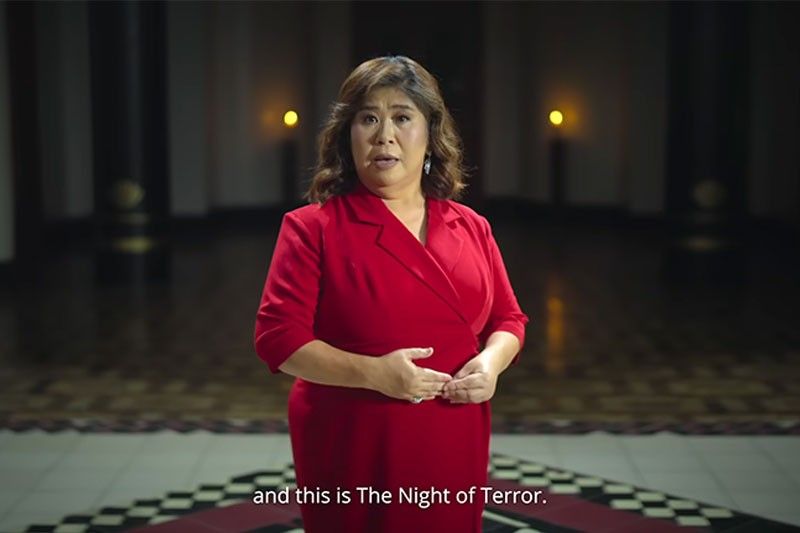
Even with a bigger budget and a grander scale fit for a cinematic experience, “KMJS’ Gabi ng Lagim: The Movie” at its core feels like another thought-provoking episode of Kapuso Mo, Jessica Soho’s iconic annual horror segment — an impression solidified by the host's closing spiel, which reminds viewers that this is more than a two-hour tale full of jump scares.
“We must fear not ghosts, elementals, nor the devil. But the evil and darkness in our society, and in ourselves,” Soho said before concluding the film.
There’s no doubt that we should be scared of an Indonesian ghost lurking at sea, an aswang-like creature terrorizing a small town, and a demon possessing a vulnerable young girl. But beneath these scares, the film attempts — sometimes more successfully than others — to offer social commentary about the ills of society, which, in real life, may feel like the scariest story of all.
‘Pocong’
The film opens with Miguel Tanfelix as Mark, a newly hired seaman who has ghostly visions. While this usually doesn’t bother him, he becomes increasingly unsettled by the presence of a mummy-like figure called the Pocong. In Malay and Indonesian folklore, pocongs are ghosts trapped on Earth due to an incomplete burial, forced to hop to move.
As the Pocong claims victim after another, Mark fears for his life and the people around him, with almost no means of escape.
At best, this segment is carried by Tanfelix’s committed performance and the visual effects-heavy look of the Pocong, which makes the creature truly terrifying. Unfortunately, those are among the few strengths of this first story.
Even with its short runtime, the episode feels dragging due to shallow characterization that fails to keep viewers invested or concerned for the characters. Many horror films use slow-burn storytelling to explore a character’s psyche before delivering the big scares, but here the pacing only highlights the weak writing.
It also doesn’t help that the episode uses artificial intelligence to generate exterior shots of the ship, resulting in off-putting and inconsistent visuals that clash with the real footage. It’s a solid example of why relying heavily on AI can be a poor filmmaking choice.
If you happen to arrive late to a screening, you’re honestly not missing much in “Pocong.” Two stars out of five.
‘Berbalang’
Set in the Southern Philippines in the 1960s, the second episode follows a small town haunted by a Berbalang that feeds on human organs.
Sanya Lopez plays Delilah, a mortal who keeps her berbalang brother, Kain (Elijah Canlas), hidden while Sheriff Leland (Rocco Nacino) investigates the deaths and searches for not one but two creatures terrorizing the town — the second of which has no connection to Delilah and Kain.
But don’t expect a simple good-versus-evil tale. The short highlights the corruption of Leland and his subordinate Cisco (Mikoy Morales), who won’t hesitate to kill if it allows them to maintain power.
“Berbalang” best embodies Soho’s closing message about fearing the darkness within ourselves. It uses its limited runtime efficiently to explore themes of abuse and power dynamics, presented through heavily stylized storytelling reminiscent of a Quentin Tarantino spaghetti Western blended with the adventure-horror energy of “Buffy the Vampire Slayer.”
Writer-director Dodo Dayao clearly had a strong vision for his contribution, and it shows. The story’s high quality — enhanced by effective angling and shot choices — amplifies his storytelling, making it easier to overlook some of the distracting and subpar CGI.
Lopez, Canlas, and Nacino deliver strong performances that elevate the segment, especially during its action-driven sequences.
Among the three stories, “Berbalang” alone is worth the price of admission, as it is arguably the strongest entry in the film and one that deserves its own sequel. Four stars out of five.
‘Sanib’
The film concludes with a classic exorcism tale centered on Angel (Jillian Ward), a young girl possessed by a powerful demon on the same day her estranged mother, Lita (Lotlot De Leon), returns from overseas. Years of resentment and teen angst leave Angel vulnerable to the demon’s influence.
Fr. Rex and Fr. Azul (Martin del Rosario and Epy Quizon) are tasked with driving the malevolent entity out of Angel’s body, struggling to recall the demon’s name, which is crucial to completing an exorcism.
Out of the three, “Sanib” most effectively uses familiar horror tropes to deliver genuine scares, even if it feels reminiscent of past possession films. It also feels the most traditionally “KMJS,” incorporating real-life footage at the start of the episode.
Ward delivers what may be her transformative, career-best performance yet, balancing Angel’s vulnerability with the demon’s malicious sassiness.
Fr. Rex has the most compelling characterization, as his past creates a powerful personal conflict that he must resolve in order to save Angel.
However, the ending holds this episode back. It offers no proper closure for its characters, making the absence of an epilogue feel like a missed opportunity for emotional payoff.
The climax also relies too conveniently on a deus ex machina, with the priests suddenly discovering the solution that had been in front of them all along.
Even with its flaws, “Sanib” is a fitting finale with enough strengths to stand out. Three and a half stars out of five.
A bit more of Soho
Each episode ends with facts related to its topic: Mark in “Pocong” and Fr. Rex and Fr. Azul in “Sanib” are based on real people whose stories are believed to be true, while “Berbalang” is the most fictionalized, adapted from a historical account by an American soldier who documented the creature.
While informative, these segments could have been presented in greater depth — perhaps through interviews with the people behind the original stories and experts on the monster figures featured — to provide a richer viewing experience beyond the scares.
While Soho’s presence is felt throughout, the film could have used even more of her —whether through additional narration or interviews with the subjects themselves.
There’s no doubt that Soho is the biggest draw for Gabi ng Lagim’s debut on the big screen, helping turn it into a surprise box-office hit. Incorporating more of her would likely be crucial if GMA Pictures and GMA Public Affairs greenlight a sequel.
“Gabi ng Lagim” has the potential to become a film franchise, offering a unique alternative to Regal Entertainment’s “Shake, Rattle & Roll” with its informative angle. If sequels do happen, stronger writing and direction, as well as a greater presence from Soho, would go a long way toward keeping viewers invested in future installments on the big screen. Three and a half stars out of five.






- Latest