


DOE beefs up efforts to avoid: Christmas in the dark

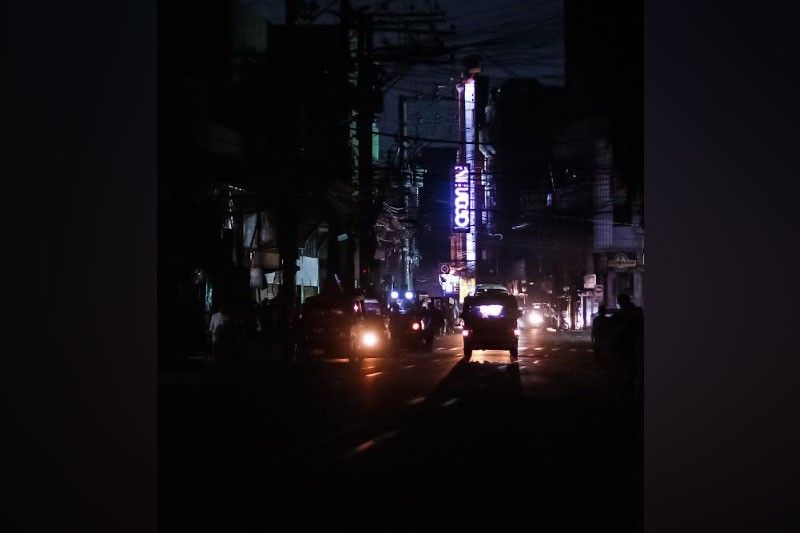
CEBU, Philippines — With rotational brownouts already affecting parts of the Visayas, including Cebu, the Department of Energy (DOE) is working on short- and long-term measures to stabilize the grid and prevent the current supply shortage from worsening as the holiday season approaches.
DOE Director for the Visayas Renante Sevilla said authorities are hoping to stabilize the power situation before the holiday period, amid concerns that the continuing supply shortage could worsen as demand increases during the “ber” months.
“We're really hoping that dili maabot anang dark Christmas,” Sevilla said, adding that the government and industry players are “really working together” to restore the system to stable operation.
The National Grid Corporation of the Philippines (NGCP) reported that the Visayas grid was under red alert from 5 p.m. to 8 p.m. and yellow alert from 8 p.m. to 10 p.m. on September 5, with available capacity at 2,255 megawatts (MW) against a peak demand of 2,432 MW.
The grid's tight supply situation was attributed partly to the unavailability of major generating units, including Therma Visayas Inc. (TVI) Unit 1 and Panay Energy Development Corp. (PEDC) Unit 3, as well as limited or unavailable power imports from Mindanao.
Supply gap
NGCP Assistant Vice President and head of System Operations–Visayas Engr. Neil Modena said the Visayas is currently facing a significant shortage of available generation capacity.
In its data, eight plants were on forced outage as of September, while six plants had been unavailable since August, one since July, two since June, seven since May, three since 2025, two since 2024, two since 2023, and one since 2021.
Another 15 generating plants were operating at derated capacities, resulting in a total of 797.8 MW unavailable to the grid.
“The situation nato karon, ni grabi,” Modena told the media in a press conference held Friday, September 5, at the Cebu Provincial Capitol.
He noted that NGCP had declared the unavailability of several plants affecting the entire Visayas system.
He said the Visayas grid has a demand of about 2,700 MW, with Cebu accounting for roughly half of regional consumption, or around 1,350 MW.
The high demand means Cebu cannot rely solely on its local generators and remains dependent on electricity transferred through the interconnected Visayas grid from other islands.
Modena said the grid recorded a peak demand of around 2,300 MW in January, while the highest peak recorded this year reached about 2,700 MW on May 14.
He explained that NGCP monitors the condition of power plants and the consumption of electricity users to determine how the available supply can be managed against demand.
Rotational brownout explained
When supply becomes insufficient, NGCP directs distribution utilities to remove portions of electricity demand from the system to prevent a wider grid collapse.
“Para na manage namo ang supply ug demand, dili ma blackout, manangtang gud mi og load,” Modena said.
Distribution utilities such as Visayan Electric Company (VECO) and the Cebu Electric Cooperatives implement the resulting rotational brownouts based on the amount of load reduction required by NGCP.
CEBECO III General Manager Virgilio Fortich Jr. said the areas affected by the rotational brownouts depend on how much load NGCP requires the distribution utilities to drop at a given time.
“Ang basis sa rotational brownout mag-agad sa gidak-on sa e drop sa gi require ni NGCP,” Fortich said.
He explained that the affected areas are not permanently assigned because the required load reduction changes depending on the condition of the grid.
“Every hour mag-usab usab ni, di ni siya mag permanente,” Fortich said.
VECO OIC President and General Manager Engr. Mark Anthony Kindica likewise said the distribution utility's schedule depends on the allocation provided by NGCP, stressing that the amount can change from one period to another.
Kindica said VECO normally implements about one-hour interruptions, but the duration can extend when the required load reduction becomes significantly larger.
On September 3, VECO had to remove about 130 MW of load, resulting in brownouts extending to around two hours in some areas.
Hospitals and other facilities with critical loads are excluded from the rotational brownout schedule, Fortich said, as maintaining their electricity supply is part of basic operating protocol.
“Wana mi choice karon to turn off the feeders. Except those feeders that are provided by the hospitals,” Fortich said.
Power barges eyed
For the immediate response, authorities are looking at the deployment of two power barges, one intended for Cebu and another for Panay, to provide additional generating capacity while longer-term projects are pursued.
The barges are expected to come from Luzon and arrive within September.
“Within the month, e try jud nila,” Sevilla said.
The DOE is also pushing for additional ancillary services and other interventions to help stabilize the grid in the short term. Longer-term efforts, on the other hand, focus on bringing additional power generation facilities online.
Sevilla said the long-term solution remains the development and implementation of additional power plants in Cebu, including the P7.5-billion, 150-MW Daanbantayan Solar Project and developments involving the Alegria oil and gas field.
The DOE has also been pressing NGCP to expedite the connection and energization of battery energy storage systems across the Visayas.
About 170 MW of BESS capacity is being deployed in Cebu, Negros, and Panay, alongside a planned 20-MW modular diesel generating set.
A 60-MW battery energy storage project in Naga City, led by Aboitiz Power Corp., broke ground on July 1 and is intended to strengthen grid reliability and support rising electricity demand in the Visayas.
DOE Secretary Sharon Garin previously said the immediate interventions could improve the Visayas power situation by October, with the department hoping that red alerts would be eliminated and yellow alerts reduced to a minimum.
For now, however, the region remains vulnerable to supply shortages, with NGCP warning that insufficient generation could trigger more serious consequences if the transmission system becomes overloaded.
Modena said the rotational brownouts are necessary to prevent a much larger system failure.
“Di ta gusto mag blackout? Ngano man kay kung ma overload atong network mo collapse ta,” he said.
He recalled that during a recent critical situation, NGCP had to sacrifice power supply in northern areas to keep the wider grid from collapsing. — (FREEMAN)


- Latest


