New rules sideline vice mayor: Council clips Tom’s powers
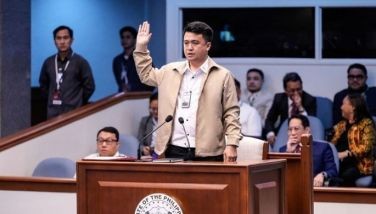
CEBU, Philippines — After a cordial exchange during the State of the City Address, the Cebu City Council descended into a tense session lasting more than an hour that culminated in the adoption of a new set of house rules, effectively limiting Vice Mayor Tomas Osmeña's legislative powers and barring him from chairing any committee.
Councilor Jaypee Labella moved for the adoption of the new rules. Minority Floor Leader Councilor Sisinio Andales immediately objected, citing procedural due process.
He argued that council members had not been informed of the revisions or given sufficient time to study them, saying it was the first time he had seen the proposed house rules.
According to Andales, the council was rushing the approval without allowing members to fully examine or question the changes. He then pointed to several provisions that had been removed or amended.
Andales cited Article II, Section 3, Paragraph D, which previously allowed the presiding officer to participate in deliberations after relinquishing the chair.
He noted that the provision had been deleted and replaced with a requirement that the presiding officer remain impartial throughout the proceedings.
He also questioned the deletion of Article IV, Section 2, which had allowed the Vice Mayor to chair committees, noting that previous councils had permitted presiding officers to head committees.
Andales likewise raised concerns over Article X, Section 1, which formerly required ordinances and resolutions to receive the vice mayor's approval before filing. He asked why the phrase "upon the approval of the vice mayor" had been removed.
He further objected to Article VIII, Section 4, Paragraph C, which now states that "no amendments shall be allowed," saying the restriction did not exist in the 2025 house rules.
Andales argued that the deletions effectively curtailed the powers of the vice mayor and questioned the timing of the revisions, suggesting they were politically motivated because the vice mayor belongs to a different political party.
He also demanded copies of the Department of the Interior and Local Government (DILG) opinion cited by the majority, saying he could not be expected to accept the changes "hook, line, and sinker" without supporting documents.
He maintained that presiding officers are traditionally allowed to participate in debates and accused the council of silencing the minority.
Councilor Mikel Rama responded by citing DILG Opinion No. 95, Series of 2025, which interprets Section 49 of the Local Government Code, as well as Supreme Court rulings in Zamora v. Caballero and Javier v. Cadiao.
Rama said presiding officers represent the entire body rather than a particular district and must therefore remain impartial, voting only in the event of a tie. A lawyer by profession, Rama said the deletions merely aligned the house rules with existing law and DILG guidance.
He acknowledged that DILG opinions are merely recommendatory but emphasized that they serve as guidance for local government units.
“Otherwise, walay gamit ang DILG kung mao ng estoryaha,” Rama said.
Andales countered that the DILG opinion was not conclusive. In fact, an undersecretary made a note stating that such opinions are based solely on the facts presented and are without prejudice to contrary rulings.
Andales reiterated that the council was acting without due process and argued that the vice mayor, as head of the legislative department, should retain approval powers over measures before filing.
Councilor Philip Zafra manifested that while the vice mayor should ideally be allowed to express his views, the council remained bound by the DILG opinion.
He later proposed a minor amendment deleting the one-year prohibition on amending the house rules, thereby allowing the council to revise them at any time.
Councilor Paul Labra supported Zafra's proposal and suggested that future amendments be prepared by a bipartisan working group, noting that councilors had received the revised rules only that afternoon and that some signatures were still missing.
Councilor Dave Tumulak then questioned how the council could operate if the house rules had already been approved while simultaneously being referred to the oversight committee.
Zafra clarified that the house rules had already taken effect and that the referral was merely for further study and review, not to suspend their implementation.
“A review does not tantamount to not approving it. We already have approved our house rules. There is already house rules,” he said.
Councilor Winston Pepito added, “So it’s referred for review,” with Pepito saying it was for “further study and review lang.”
Zafra subsequently introduced another corollary motion referring the matter to the DILG for clarification regarding the council's differing interpretations of the opinion. The motion was seconded, drew no objections, and was approved.
Key reforms
Apart from redefining the vice mayor's role, the new house rules introduce several procedural reforms aimed at strengthening transparency, legislative procedures, and fiscal oversight.
Executive sessions will now be presumed open to the public unless a majority of council members vote to hold a closed-door meeting on grounds of security, decency, morality, or public interest.
Public hearings are now mandatory for tax and penal ordinances, while council minutes and journals must be distributed to members in advance.
The rules also tighten committee procedures by limiting standing committee membership to elected and ex-officio members, requiring committee reports to be circulated at least two days before presentation, and restricting final committee deliberations to members and invited resource persons.
The ordinance approval process has likewise been clarified through a strict three-reading requirement.
Measures will undergo committee referral during first reading, full reading of the proposed ordinance and committee report with debates and amendments during second reading, and title-only reading followed immediately by final voting on third reading, where amendments and debate are no longer allowed.
Publication requirements have also been strengthened. Ordinances must now be published in a local newspaper within 10 days after approval, tax ordinances will take effect 30 days after publication, while penal ordinances must be posted at City Hall for three weeks. Certified copies are likewise required to be transmitted to the Official Gazette for archival purposes.
The new rules also expand fiscal oversight by requiring any resolution authorizing the City Mayor to sign contracts to be accompanied by draft agreements and certifications from the city legal, budget, and treasury offices.
Programs funded through special funds, including PAGCOR allocations, must comply with national guidelines and secure the Mayor's approval. Once contracts are executed, notarized copies must also be submitted to the Sanggunian for record-keeping. — /FPL (FREEMAN)


- Latest