ASEAN raises 2026 growth forecast to 4.7%

MANILA, Philippines — The Association of Southeast Asian Nations (ASEAN) has raised its economic growth forecast for this year to 4.7% from 4.5%, although rising food and energy prices and tensions in the Middle East continue to threaten the region's outlook.
Trade Secretary Ma. Cristina Roque announced the revised forecast during the 39th ASEAN Coordinating Council meeting on Saturday, November 14, ahead of the 49th ASEAN Summit.
"Despite an increasingly challenging global environment, ASEAN's economic outlook remains relatively resilient," Roque said in remarks livestreamed on the Presidential Communications Office's official Facebook page.
The region's economy is expected to grow by 4.7% in 2027, she added.
Roque, however, said high food and energy prices, prolonged conflict in the Middle East, disruptions to energy markets and critical shipping routes, and the prospect of a strong El Niño continue to pose challenges to households, businesses and the agriculture sector.
On ASEAN's economic agenda, Roque said the bloc is on track to complete all 19 priority economic deliverables under the Philippines' chairship.
Fourteen are expected to be completed by the 49th ASEAN Summit, while the remaining five are targeted for completion by December.
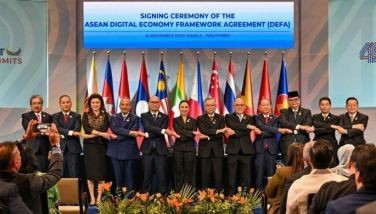
The signing of the ASEAN Digital Economy Framework Agreement (DEFA) is among the major developments under the Philippines' chairship.
Roque said the agreement would open opportunities for regional cooperation in digital transformation and economic development.
"Our task now is to ensure that they move beyond commitments and translate into practical support and opportunities for businesses, especially MSMEs and our people," she said.
Meanwhile, the ASEAN Economic Community (AEC) Pillar has completed 87% of the activities under the AEC Blueprint 2025 as of November, equivalent to 3,379 activities, Roque said.
She said the bloc must complete the remaining activities and ensure that the blueprint's commitments benefit businesses, workers and communities.
Foreign Affairs Secretary Ma. Theresa Lazaro, meanwhile, said ASEAN had maintained its unity despite geopolitical tensions, economic uncertainty and other challenges confronting the region.
"ASEAN has shown that unity and solidarity are more than aspirations, they are the sources of our strategic capacity," Lazaro said.
She cited progress in maritime cooperation, economic integration, social protection and regional security during the Philippines' chairship.
Lazaro also said the region's security, economic growth and social resilience must be pursued together.
"ASEAN security, prosperity, and social resilience cannot be advanced in isolation," she said.
Social Welfare Secretary Rex Gatchalian, for his part, said the Philippines had pushed for a regional agenda focused on families, communities and inclusive development.
He cited initiatives on family resilience, youth leadership, digital innovation, environmental sustainability and food security.
"One important lesson from our chairship is that the quality of regional cooperation is ultimately reflected in the difference it makes in people's lives," Gatchalian said.
He said ASEAN's commitments must translate into policies and services that address the needs of communities, particularly those exposed to economic uncertainties and environmental risks.
"A more prosperous and secure ASEAN must also be one where people have the opportunity to participate, contribute, and live with dignity," he said.
The Philippines assumed the ASEAN chairship this year under the theme "Navigating Our Future, Together." Singapore will take over the chairmanship in 2027.





- Latest
- Trending